


Tameobit is home


Lake Los Angeles, CA.- Olivia Miseroy, Regional Park Superintendent I, Wildlife and Wildflower Sanctuaries, County of Los Angeles Department of Parks and Recreation - Natural Areas Division, who now has her own office on the Community Gymnasium pad, is pictured here with her photographing of natural flora at Tameobit Preserve BioBlitz.
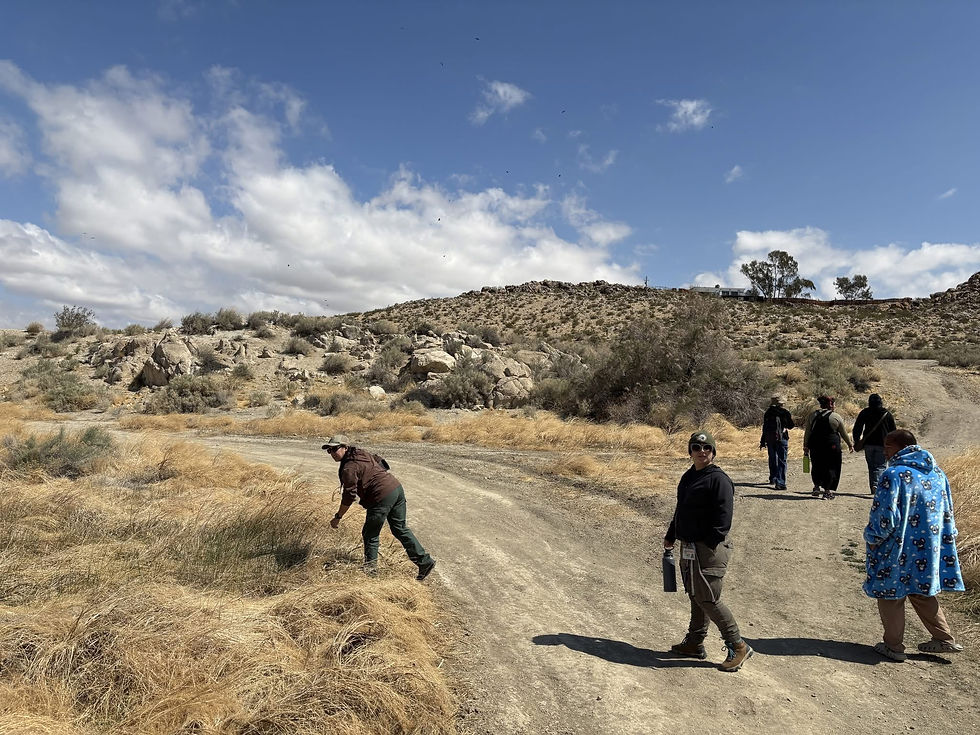
During the BioBlitz at Tameobit Sanctuary of Saturday April 19, the group experienced 14 total observations, with 42 species found.
Eden Pitt with the Antelope Valley Audubon Society, co-host for the day said, "What people may not realize as well is that the spring, while it’s disappeared above water, still exists as groundwater. We saw plenty of invasive trees like Tamarisk and Arrundo grass, likely sucking up lots of groundwater. We also saw a line of Joshua trees growing, some juvenile, that could potentially indicate where the underground spring is flowing."
The BioBlitz was led by Alana Dixon, who is a board member for the California Native Plant Society - San Gabriel Mountains Chapter and Eden Pitt of the Antelope Valley Audubon Society Secretary. This was a partnership event between the two organizations.
It was such a great moment and privilege for this community and for Olivia to have enjoyed such a successful day in our own precious Tameobit Preserve.

Report to the community
BioBlitz at Tameobit Sanctuary
Saturday, April 19
By Eden Pitt
Antelope Valley Audubon Society Secretary
Lake Los Angeles – Tameobit Sanctuary - We hosted a BioBlitz, which is when a group of volunteers identify as many species as they can within a set amount of time at a specific location. So, we did this at the Tameobit Wildlife Sanctuary from 10am-1pm.
We used the app, iNaturalist, to catalogue the species. It lets you take pictures of any plant/animal/fungi and tags the location of it, as the observer you can narrow it down to the closest classification you can. iNaturalist is a network of nature enthusiasts and scientists with millions of observations on the site. It helps scientists figure out where certain species are and the possible movement of them on a worldwide scale. Many groups who host BioBlitzes use the app for this reason.
The BioBlitz was led by Alana Dixon, who is a board member for the California Native Plant Society - San Gabriel Mountains Chapter and me, Antelope Valley Audubon Society Secretary. So, this was a partnership event between the two organizations. This was our final stewardship project for a certification course we’re both taking which is called UC California Naturalist: Introduction to the Mojave Desert. While the UC California Naturalist program has been around for years, this was the first year they’re hosting a Mojave specific course. I’d like to give a huge shout out to the teacher of the course, Sarah Berryman, and Director of Conservation for Transition Habitat Conservancy (THC). THC is truly a leader in Mojave Desert conservation, and we’ve learned so much from their team. Sarah was with us to help identify species and support the group! We also had Olivia Miseroy, Regional Park Superintendent I, Wildlife and Wildflower Sanctuaries, County of Los Angeles Department of Parks and Recreation - Natural Areas Division.
We had 12 total participants, which was a great turnout in my opinion. You can see our iNaturalist project, which compiled all the observations we made: https://www.inaturalist.org/projects/uc-california-naturalist-stewardship-mojave-desert-bioblitz?tab=observations We made 114 total observations, with 42 species found! Some of the native plants included Mojave Woodyaster (purple wildflowers), flowering Creosote (with how much Creosote we have in the Desert, I haven’t seen as many flowering as we did here!), and California Buckwheat at various stages. We also found remnants of a Cottontail Rabbit, a running California Thrasher, what might have been a Red Tailed Hawk in the sky.
Also, Lake LA is such an interesting area geologically and historically. On the rocks at the sanctuary, they have “veins” that go straight through the outsides of them. As you mentioned, the area used to be a spring, so those veins were caused by previous rapid water movement. We also found many natural holes in the rocks, or rocks piled up to create a nice little shelter for critters. There’s a lot of Desert Varnish as well, which turned some of the rocks almost black. This is a layer of minerals and erosion that builds overtime. What people may not realize as well is that the spring, while it’s disappeared above water, still exists as groundwater. We saw plenty of invasive trees like Tamarisk and Arrundo grass likely sucking up lots of groundwater. We also saw a line of Joshua trees growing, some juvenile, that could potentially indicate where the underground spring is flowing. It’s also very important to recognize that the area is on Ferdaneno Tataviam tribal lands.
Ultimately, I think a lot of people assume dryness equals little life. People generally enjoy seeing water, lush greenery, and colorful plants. I’ll be the first to admit, growing up in Palmdale, I craved to be in those environments as I felt this one was barren. As an adult, I realize I couldn’t have been more wrong. We do have those things in the Mojave. We have vast, complex underground root and water systems. Above ground, we have fascinating ancient geological formations and beautiful biodiversity! Wherever I see fields of Joshua Trees, a vivid wildflower pop out, the scent of Creosote, and many rabbits, reptiles, and unique birds around me, I know I’m home. Now, the many talented and skilled people I've met through AV Audubon, CNPS-SGM, and Transition Habitat Conservancy have inspired me to help preserve, protect, and promote the appreciation of our Mojave Desert.
As a representative of AV Audubon, I can guarantee we’ll continue to host conservation events like these to gather a sense of community and action for the amazing desert around us.
I’d like to thank everybody who attended the event and supported the project!
Comments