


Secretary of State Shirley Weber, Assemblymember Juan Carrillo Discuss Voting, Youth Engagement and Civic Participation


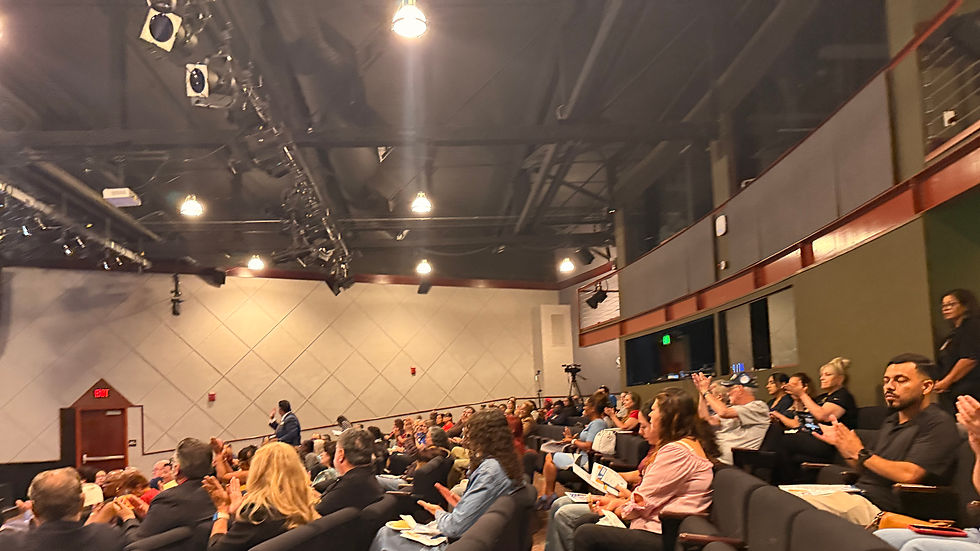
PALMDALE, Calif. — California Secretary of State Dr. Shirley N. Weber joined Assemblymember Juan Carrillo on Friday morning at the Palmdale Playhouse for a community conversation focused on voting, election accessibility, youth participation, public service and civic engagement.
The Oct. 2 Community Coffee was moderated by Antelope Valley College
Superintendent/President Dr. Jennifer Zellet. Residents, community leaders and elected officials were among those in attendance. The event was promoted as an opportunity for residents to hear a legislative update and learn about voter education ahead of California’s Nov. 3 General Election. (Antelope Valley College)
Weber Shares Personal Story and Passion for Voting Weber spoke about her personal experiences, including the influence of her father and the experiences that helped shape her commitment to voting rights, education and public service.
Throughout the discussion, Weber stressed that elections are a serious responsibility in a state as large and diverse as California and that ensuring access means reaching voters with different needs.
She discussed accommodations for voters with disabilities, including accessible polling locations, assistance for people with visual or reading disabilities and other measures designed to allow eligible voters to independently participate in elections.
Language access was also discussed. California’s statewide voter information guide for the November election is available in many languages: English, Spanish, Chinese, Hindi, Japanese, Khmer, Korean, Tagalog, Thai and Vietnamese. Audio and large-print versions are also available. (California Secretary of State)
Getting Younger Californians Involved
A significant portion of the conversation focused on younger voters, particularly the difficulty of engaging young adults roughly ages 19 to 25.
Speakers discussed reasons some young adults may feel disconnected from government or believe their participation will not make a difference. Weber encouraged families and communities to begin civic education earlier.
She highlighted opportunities for high school students to participate in elections by working at polling locations and learning firsthand how elections operate. College voter-registration efforts and campus activities were also discussed as ways of building participation among younger Californians.
The broader message to young people was to become involved with their communities, develop knowledge, find a sense of purpose and be willing to work for change.
Carrillo: Change Can Begin Locally
Carrillo shared his own path into public service, explaining that he immigrated from Guadalajara, Jalisco, and originally envisioned becoming an architect or engineer before eventually becoming a city planner.
He said his experience working in local government and observing how Latino and Hispanic community members interacted with government contributed to his decision to become more involved.
Carrillo pointed to school boards, city councils, water districts and other local bodies as places where residents can directly participate in government and seek changes in their communities.
He also spoke about the sacrifices associated with elected office and said public service should not be about fame or money.
Weber offered a similar message when asked what advice she would give young people interested in politics. She encouraged them to first become active in their communities, work hard, act with integrity and approach public service with purpose rather than seeking recognition.
Immigration Enforcement and Election Concerns
During the audience question-and-answer portion, Carrillo was asked about immigration enforcement and concerns surrounding ICE.
Carrillo discussed recently enacted California legislation addressing federal immigration enforcement and said the state has taken steps involving schools, hospitals and other institutions. Gov. Gavin Newsom signed a package of 21 immigration-related bills on Sept. 29 covering issues including detention oversight, federal enforcement transparency, civil rights and state facilities. (Governor of California)
Carrillo also discussed concerns about intimidation around voting locations and emphasized that residents should be able to participate in elections without fear.
California separately enacted an election-protection package in September that modifies prohibited activities near polling locations, expands language-access provisions and creates or strengthens protections against interference with election materials and systems. (Governor of California)
Weber Encourages Californians to Vote Early
Weber repeatedly encouraged eligible Californians to exercise their right to vote and to vote early when possible.
She discussed the importance of properly completing and signing vote-by-mail ballots and responding when election officials notify a voter that a signature problem needs to be corrected, or “cured.”
According to the Secretary of State’s office, county elections officials are required to begin mailing ballots to active registered voters by Oct. 5. Ballots may be returned by mail, at authorized drop-off locations or county election offices, while early in-person voting is also available. Election Day is Tuesday, Nov. 3, and polls will be open from 7 a.m. until 8 p.m. (California Secretary of State)
“Make sure you take advantage of every opportunity to vote that you have,” Weber told attendees, describing voting as critically important.
“Be Active. Join Something.”
In her closing remarks, Weber broadened the conversation beyond elections.
She encouraged residents who feel their communities are being overlooked to become directly involved rather than waiting for change to come from Sacramento.
“Be active. Join something,” Weber told the audience.
She said resources can come from the state, but much of the work of strengthening communities comes from residents themselves—people who identify problems, develop ideas, organize and work with elected officials.
Carrillo closed by emphasizing the importance of maintaining two-way communication between residents and their representatives. He encouraged High Desert residents to contact his district office and said he hopes to continue bringing statewide officials and other government leaders to the region so residents can interact with them directly.
Carrillo also spoke about what he described as economic challenges facing High Desert communities and his efforts to bring state resources into the 39th Assembly District.
He thanked Weber for visiting the Antelope Valley and thanked attendees, including those who traveled from the Victor Valley, for participating.
The event concluded with officials remaining at the Palmdale Playhouse to speak individually with community members.
California’s Nov. 3 General Election will include statewide constitutional offices, congressional and legislative races, judicial offices and 14 statewide ballot measures. County elections officials are scheduled to begin mailing ballots by Oct. 5. (California Secretary of State)
Election information: Voters can obtain official registration, ballot, early-voting and election information through the California Secretary of State Elections website.
Comments